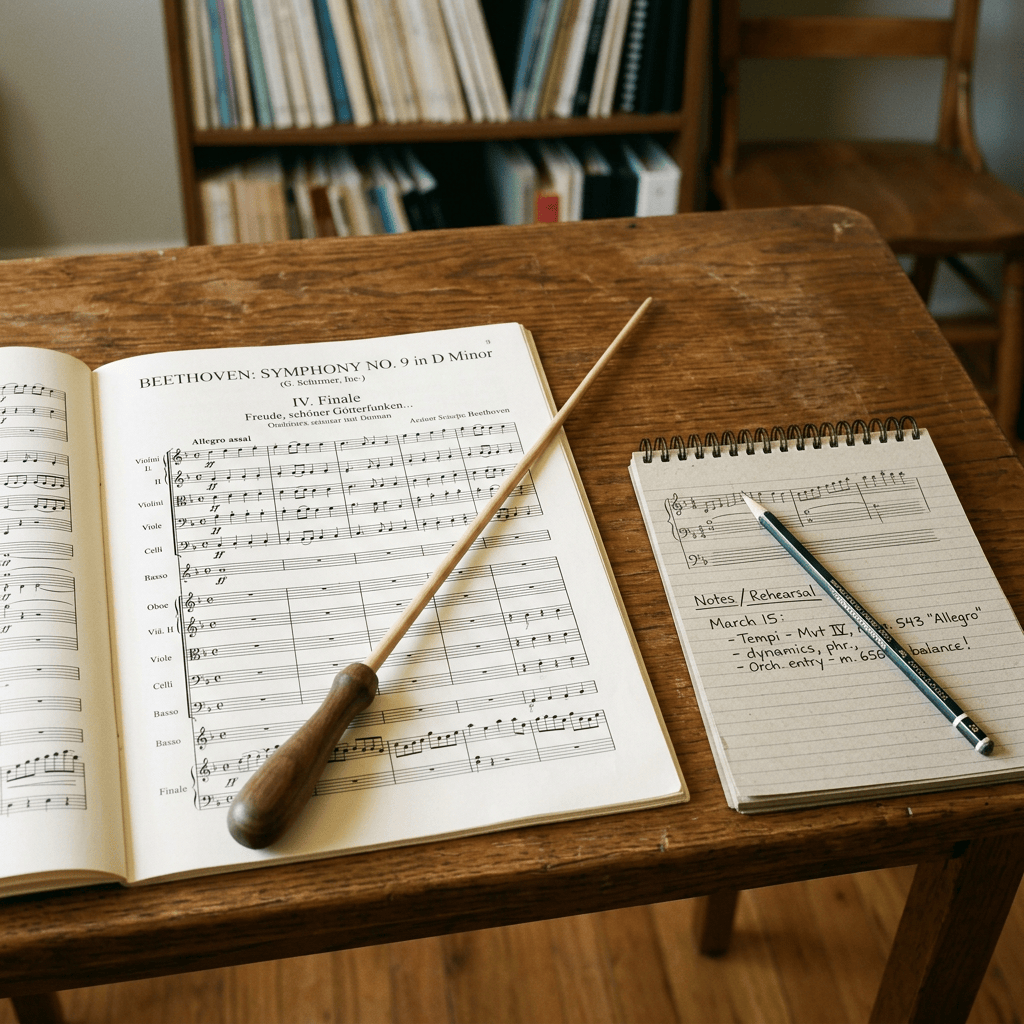
Knowing the music is not the same as knowing how to teach it
When we select music, we are selecting the curriculum we use to guide musical learning in our classroom. Score study helps you understand the structure, style, and expressive possibilities of a composition. Instructional planning begins when you ask what your students must hear, understand, and do to bring those possibilities to life. One useful sequence is:
Score observation → student demand → first task → evidence → next decision
Begin where the score and the students meet
Planning begins where the demands of the score meet your students’ present knowledge and skills. Score analysis allows us to determine what students will need to know and do as musicians performing the composition. A passage in the score may require different kinds of instruction depending on the students sitting in the ensemble.
Your job is to connect what the music requires with what your students already know and what they still need to learn.
Score study helps you predict where students may need support. Their performance tells you whether your prediction was correct.
As you compare the demands of a piece with the ensemble you teach, consider the following:
- What have students already learned that they can apply here?
- Where is technical development uneven across the ensemble?
- How does the available instrumentation or voicing differ from the score?
- What range or tessitura will students encounter?
- Which notation will be familiar or unfamiliar?
- How independently can each section perform?
- How well can students hear balance, blend, and function across the ensemble?
You cannot address every demand at once. Begin with the demand that prevents students from hearing or performing the larger musical idea. Sometimes that will be rhythm or range. At other times, students may need to hear the melody, feel the meter, or understand how their part functions before technical correction will make sense.
The score suggests the musical destination. Knowledge of your students helps you decide where instruction should begin.
Overlapping layers of demand
As you plan, look for four overlapping layers of demand: musical orientation, individual execution, ensemble coordination, and interpretation and independence. They are not fixed stages. Several may be present in the same passage or rehearsal.
| Layer | Planning question | What to notice |
| Musical orientation | Before students perform the details, what should they hear or experience first? | Tonality, pulse, meter, style, form, character, and complete musical ideas. |
| Individual execution | What must students be able to execute independently? | Notes, rhythms, range, articulation, diction, fingering, bowing, breath, vocal production, and technical patterns. |
| Ensemble coordination | What must students coordinate or hear across the ensemble? | Entrances, releases, balance, blend, alignment, texture, melody, accompaniment, and musical function. |
| Interpretation and independence | What must students learn to notice, interpret, and adjust without waiting for the teacher? | Phrase direction, expressive intent, style, listening priorities, self-assessment, and independent adjustment. |
Remember that these are not fixed stages. Several may be present in the same rehearsal, and expressive intent should not wait until every technical problem has been solved. Otherwise, rehearsing can become a series of corrections that loses sight of the human and artistic purpose of the music. No rehearsal should feel to the students that they are not creating music.
Turn one score observation into a rehearsal plan
Take one observation from the score and turn it into an instructional process. The following example offers a guide.
Choose a first task that is small enough for students to attempt successfully but rich enough to give you useful information.
| Planning step | Example |
| Score observation | At measure 42, the low brass enter with a syncopated harmonic foundation beneath the clarinet melody. |
| Student demands | Low brass must subdivide and enter together. Clarinets must shape the phrase. The ensemble must hear the difference between melody and accompaniment. |
| First task | Low brass clap and count the rhythm, play it on one pitch, and then perform it as written beneath the clarinet melody. |
| Evidence | The low-brass entrance is unified, articulation matches, pulse remains steady, and the clarinet melody remains prominent. |
| Next decision | Restore the full texture if the learning transfers. Reduce the texture or return to the rhythm if it does not. |
You may not need to plan every passage in this much detail. Score study is not meant to generate a complete rehearsal script. Instead, it can help you anticipate:
- A likely problem
- A logical starting point
- Evidence to observe
- At least one possible adjustment
Plan the first task and the evidence
A plan such as “Rehearse measures 42–49” may be enough shorthand for an experienced teacher who has encountered similar problems many times. An early-career teacher may benefit from identifying:
- What students will do
- What they will attend to
- What success will sound or look like
- How the result will shape the next decision
Student performance is the evidence that determines your next move.
A strong first task does two things: it moves learning forward and helps you see what students need next.
General plan: Rehearse measures 42–49 for rhythm and balance.
Instructional plan: Low brass will clap and count the syncopated entrance, perform it on a single pitch, and then play it beneath the clarinet melody. Listen for a unified entrance, matching articulation, a steady pulse, and a melody that remains prominent.
In a choral setting, the same process might begin with a passage in which one section enters independently against sustained harmony. The first task could reveal whether the difficulty comes from hearing the starting pitch, maintaining pulse, producing the vowel, or understanding a musical entrance’s musical function.
Plan decision points rather than a rigid script
We can use four branches to help make decisions in the moment:
- If students cannot perform the isolated pattern, reduce the demand.
- If they can perform it in isolation but lose it in context, reconnect it more gradually.
- If they can perform it accurately in context but without musical intent, redirect their attention to its function in the phrase or ensemble.
- If students can perform the notes but are listening to the wrong element, redirect their attention before changing the task.
Score study helps you anticipate these possibilities. Listening to your students tells you which branch to take.
Experienced teachers may make these decisions rapidly, while early-career teachers benefit from writing out likely alternatives. The more you practice instructional planning, the easier it will become to make these decisions faster. See the previous blog on mental load for early-career teachers.
Keep musical independence as the goal
We want to create a musical environment that encourages our students to gradually learn to:
- Identify the musical problem
- Describe what they hear
- Recognize the function of their part
- Propose a strategy
- Monitor the next attempt
- Explain what improved
The planning question gradually shifts from “What should I tell them?” to “What must students learn to notice without me?”
A Just in Time practice
Take a composition you are working on, choose one passage, and complete these prompts:
- The musical purpose of this passage is…
- Students will need to hear or notice…
- Students will need to execute or read…
- The first rehearsal task will be…
- I will know they are ready to continue when…
- If they are not ready, the first demand I will reduce is…
Closing reflection
Score study is not finished when you understand the composition. It becomes instructional planning when you decide what students will do first, what evidence you will observe, and how that evidence will guide your next move.
- Where in your current score do the musical demands exceed what students can presently manage?
- What first task would move them toward the musical goal while showing you what they need next?
- What will you listen or look for before deciding whether to continue, reduce the demand, or redirect their attention?
Once you know what students need next, the question becomes which rehearsal strategy will help them get there. The next post will examine how to choose that strategy and plan the next rehearsal move.


Leave a Reply